
We are living in the era of the “life hack.” Everywhere you look—whether you are a teenager scrolling through a social media feed or an adult navigating the modern workforce—the world is trying to sell you a shortcut. We are promised fitness in five minutes a day, wealth through overnight crypto investments, and deep social connection with a simple swipe.
Everything is designed to give you exactly what you want, the exact second you want it.
But deep down, you know the truth. You know that the things that come fast rarely last. You know that the cheap, instant dopamine hit of a viral video leaves you feeling emptier than before you watched it. Whether you are a young adult feeling incredibly anxious about your future, or a parent watching the next generation struggle to stick with difficult tasks, the symptom is the same: we have collectively forgotten how to wait, how to suffer a little bit, and how to earn our rewards.
We have lost the absolute superpower of delayed gratification.
When we lose the ability to delay our rewards, we lose our resilience. We quit when things get hard. We abandon our goals the moment we hit a plateau. To rebuild true strength—mental, physical, and emotional—we have to step out of the digital “instant” culture and step into an environment that actively punishes impatience.
There is no better environment on earth for this than the boxing gym.
At the Equal Chance Boxing Foundation, we see it every single day. We watch distracted, anxious, instant-gratification-addicted youth walk through our doors, and we watch the “Sweet Science” systematically rebuild their minds. In this deep-dive pillar guide, we are speaking directly to you—whether you are a young person looking to forge an unbreakable mindset, or a community leader searching for real-world solutions. We will explore the psychology of the “slow grind,” how boxing rewires the brain for long-term success, and how our founder, Ivan Redkach, uses this unforgiving sport to help people conquer their lives.
[ecbf_donate_banner_1]
The Myth of Overnight Success: Why “Now” is Destroying Our Potential
Before we can appreciate the cure, we must understand the disease. Why is delayed gratification so incredibly difficult for the modern mind to master?
The Dopamine Hijack
Your brain is wired to seek out rewards. Thousands of years ago, a reward meant finding food or shelter after a long, exhausting hunt. The brain released a chemical called dopamine after the hard work was completed.
Today, technology has completely hijacked this system. Video games, social media algorithms, and streaming platforms deliver massive floods of dopamine for doing absolutely zero work. The brain quickly adapts to this. It starts to believe that effort is unnecessary. When a young person sits down to do something that actually requires sustained effort—like studying for a difficult exam, learning an instrument, or getting in shape—their brain physically rebels. The process feels agonizingly slow and boring because there is no instant chemical reward.
The “Quit” Reflex
Because the modern world rarely forces us to endure the uncomfortable space between starting something and getting good at it, we have developed a devastating cultural “quit reflex.”
- If a diet doesn’t show results in a week, we quit.
- If a new hobby is frustrating on the first day, we drop it.
- If a relationship requires difficult conversations, we walk away.
This is the tragedy of instant gratification. It convinces us that if something is hard, it must be the wrong path. In reality, the friction is the exact place where growth happens. To build character, you must learn to live in the friction.
Enter the Ring: The Ultimate School of the “Slow Grind”
You cannot hack boxing. You cannot buy an app that will make your chin stronger, and you cannot pay a subscription fee to magically improve your footwork. When you step into a boxing gym, you are stepping back into the brutal, honest, analog world.
Here is exactly how the environment of a boxing gym forces a student to embrace delayed gratification.
The Agony of the Basics
When a beginner—especially a teenager used to instant results—starts boxing, they usually want to hit the heavy bag as hard as they can, spar, and look like a champion on day one.
The sport violently denies this request.
In a true, technique-focused gym, you do not get to hit the bag on day one. You are placed in front of a mirror. You are taught how to stand. You are taught the boxing stance—how to balance your weight, how to tuck your chin, and how to keep your elbows glued to your ribs. And you stay there. For days, sometimes weeks, the only progress you make is learning how to step forward two inches without crossing your feet. It is deeply frustrating. It is incredibly humbling. But it is the ultimate filter. It teaches the athlete that you cannot build a skyscraper on a swamp. You must have the patience to pour the concrete first.
Respecting the Three-Minute Round
In the real world, if you are bored or tired, you can just pull out your phone or walk away. In boxing, time is governed by an unyielding master: the round timer. Three minutes of work. One minute of rest. When an athlete is jumping rope, hitting the mitts, or shadowboxing, and their lungs are burning after 60 seconds, they cannot just “swipe away” the discomfort. They have to wait for the bell. They have to physically endure the remaining two minutes. They learn to pace themselves, control their breathing, and survive the immediate pain for the long-term goal of finishing the round. This is the literal, physical manifestation of delaying gratification.
The Science of Repetition: How Boxing Rewires the Brain
Boxing is often called “the Sweet Science” because it is a game of high-speed, high-stakes physical chess. The only way to get good at it is through relentless, monotonous repetition.
Building Myelin (The Skill Substance)
When you practice a physical movement, your brain builds a fatty substance called myelin around the nerve fibers that control that movement. The thicker the myelin, the faster and more automatic the movement becomes.
You cannot build myelin quickly. If you want to throw a perfect left hook, you have to throw a mediocre left hook ten thousand times. When a young athlete commits to this process, they experience a profound psychological shift. They realize that mastery is not a talent you are born with; it is a mathematical equation of time and repetition. When they finally land that perfect hook after months of failure, the dopamine hit they receive is massive, authentic, and deeply earned. They learn that the best rewards are the ones you have to bleed for.
Emotional Regulation and Patience
Instant gratification breeds impatience, and impatience breeds anger. When an impatient fighter gets hit, their ego flares up. They want revenge instantly. They swing wildly, abandon their technique, and exhaust themselves.
Boxing physically punishes this impatience. The athlete quickly learns that anger is a liability. To progress, they must learn to take a hit, breathe, reset their stance, and patiently wait for the right opening. They learn to delay the gratification of throwing a punch until the exact right, strategic moment. This level of emotional control is what separates amateurs from champions, both in the ring and in the boardroom.

Forged in the Fire: The Ivan Redkach Standard
A heavy bag cannot mentor you. To truly learn the value of the slow grind, you need to be guided by someone who has walked the longest, hardest roads themselves. You cannot learn patience from someone who took a shortcut.
At the Equal Chance Boxing Foundation, our entire philosophy of character development is driven by our founder and Head Coach, professional boxer Ivan Redkach.
A Career Without Shortcuts
Ivan’s life is a masterclass in delayed gratification. He did not achieve his success through viral fame or easy matchups. His foundation was built in the famously harsh, hyper-disciplined sports boarding schools of Shostka, Ukraine. In that system, you are not praised for your potential; you are tested daily on your execution.
Ivan fought hundreds of amateur bouts, grinding for years in the shadows before ever tasting the bright lights of a professional arena. When he immigrated to the United States, he faced a new mountain of adversity: a new language, financial struggles, and the unforgiving business of professional combat sports. He survived these trials relying on the exact same tool he teaches today: unrelenting, methodical patience.
Authentic Mentorship for the Next Generation
When a young adult walks into our facility, completely burnt out by the anxiety of the digital world, Ivan meets them with profound empathy—but absolute, uncompromising standards.
He is one of the most effective positive role models for at-risk youth because he does not coddle them. If an athlete complains that a drill is “taking too long,” Ivan does not lower the standard. He points to his own scars. He uses his lived experience to prove that anything worth having requires suffering through the plateau. By holding the youth to a standard of excellence, he shows them that he believes they are capable of greatness—if they are willing to put in the time.
Take the First Step: The Grind is Open to Everyone
If you are a teenager reading this, tired of feeling anxious, distracted, and unaccomplished, the path to building true confidence is right in front of you. If you are a parent or community member reading this, desperate to provide your youth with an environment that builds real-world grit, the solution exists.
However, the reality of modern sports is that elite training is usually prohibitively expensive. High gym dues and the cost of gear create a massive financial barrier, effectively locking the youth who need this discipline the most out of the building.
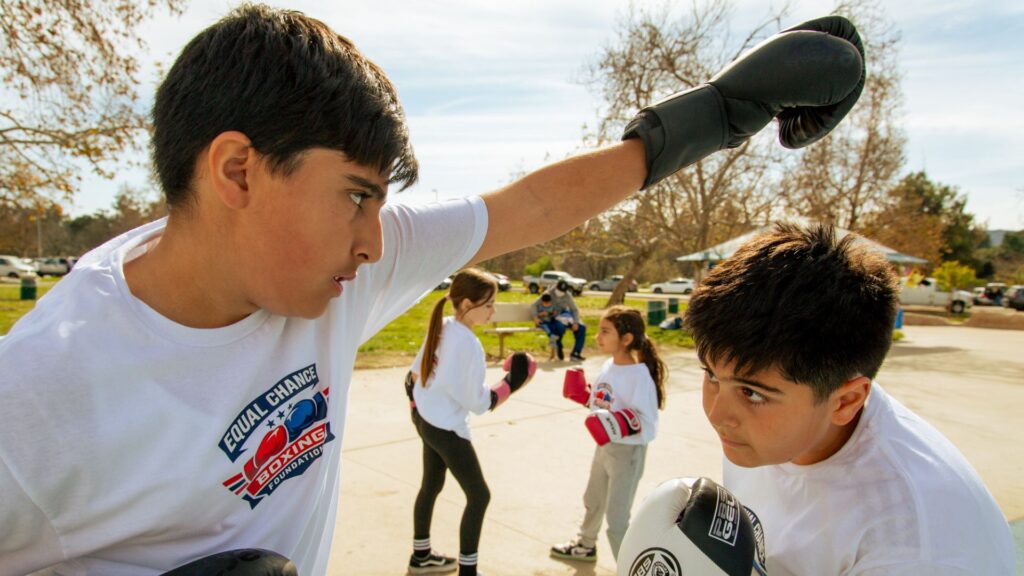
The Equal Chance Boxing Foundation believes that the opportunity to build character, patience, and physical strength is a fundamental human right. We are fiercely proud to operate a world-class, 100% free athletic sanctuary.
The Youth Boxing Program
We have completely removed the financial friction so that the only thing you have to worry about is the work.
- Absolutely Free: No registration fees, no monthly dues, and no hidden costs.
- Elite Gear Provided: We supply all professional-grade safety equipment, ensuring that every athlete trains under the strictest safety protocols without touching their family’s budget. If you are ready to stop looking for shortcuts and start building a foundation that will last a lifetime, it is time to step up. START YOUR JOURNEY: ENROLL IN OUR FREE YOUTH BOXING PROGRAM
Breaking Boundaries with Community Training
We know that a long commute can kill a routine. If you cannot get to our main facility, we bring the grind to you. Our mobile outreach programs bring our professional coaches, safety gear, and structured discipline directly into local parks and underserved neighborhoods. FIND OUT MORE ABOUT OUR MOBILE COMMUNITY TRAINING
[ecbf_donate_banner_4]
Stand in the Corner: Fuel the Fight for the Next Generation
Providing a state-of-the-art facility, elite protective equipment, and thousands of hours of high-level mentorship from athletes like Ivan Redkach to hundreds of youth—all for free—is a monumental undertaking.
We are only able to provide this life-changing environment through the vision, courage, and generosity of our donors and community partners.
When you look at a generation paralyzed by instant gratification, it is easy to complain. It is much harder to build the solution. When you support the Equal Chance Boxing Foundation, you are actively funding the antidote. You are buying a young person the time, space, and mentorship they need to learn the invaluable lesson of delayed gratification.
For Individual Donors
Be the quiet strength in a young athlete’s corner. Every single dollar you contribute keeps the lights on, replaces worn-out gloves, and ensures that when a kid decides they are ready to do the hard work, our doors are open. SUPPORT THE GRIND: DONATE TO THE FOUNDATION
For Corporate Sponsors
Businesses have the unique power to shape the resilience of their local communities. By partnering with ECBF, your brand aligns itself with the core values of grit, long-term investment, and profound youth development. Invest in the future workforce by helping us teach them the value of hard work today. LEAD THE WAY: BECOME A CORPORATE SPONSOR
Disconnect to Reconnect. Learn to Wait.
Why does progress in boxing teach delayed gratification? Because the sport fundamentally refuses to give you anything you have not earned.
The modern world will continue to scream that faster is better. It will try to sell you the illusion that you can have the reward without the struggle. But when you wrap your hands, step onto the mat, and face the mirror, the noise stops. You are left with the beautiful, undeniable truth: you get exactly what you work for.
Whether you are a young person looking to forge an iron mind, or an adult looking to support the next generation of resilient leaders, the heavy bag is waiting.
At the Equal Chance Boxing Foundation, Ivan Redkach and our entire coaching staff are dedicated to helping you fall in love with the slow grind. It is time to disconnect from the cheap dopamine of the screen, embrace the struggle, and discover the profound, lasting pride that only comes from doing things the hard way.
Questions?
We’ve got answers.
In a world of one-click solutions, boxing is stubbornly slow. You cannot “download” a perfect left hook or “stream” physical endurance. Every skill must be earned through sweat and repetition. At the Equal Chance Boxing Foundation, we teach youth that the frustration of not being good *right now* is simply the price of entry for being great later. This shift in perspective helps them value the process over the immediate result.
Mastery in boxing comes from doing the “boring” things exceptionally well, thousands of times. When a student spends weeks perfecting a single stance or movement, they learn to find satisfaction in incremental progress. They begin to understand that mastery is a marathon, not a sprint. This patience naturally carries over into their studies and personal goals, where they learn to stay the course even when the “finish line” is months or years away.
Yes. Many students give up on difficult subjects because they don’t see immediate results. Boxing provides a physical laboratory for resilience. Under the mentorship of Ivan Redkach, youth experience “plateaus” where they feel they aren’t improving, only to have a breakthrough a week later. By navigating these cycles in the gym, they develop the “stomach” for academic challenges, realizing that “not knowing yet” is just a temporary state on the way to mastery.
The ability to wait and work for a reward is one of the highest indicators of future success. Boxing reinforces this every day. A student learns that skip-roping today leads to better breath control next month, which leads to a better performance next year. This forward-thinking mindset helps them resist impulsive, short-term peer pressure and focus on the person they want to become. They stop looking for the “easy way” and start looking for the “right way.”