
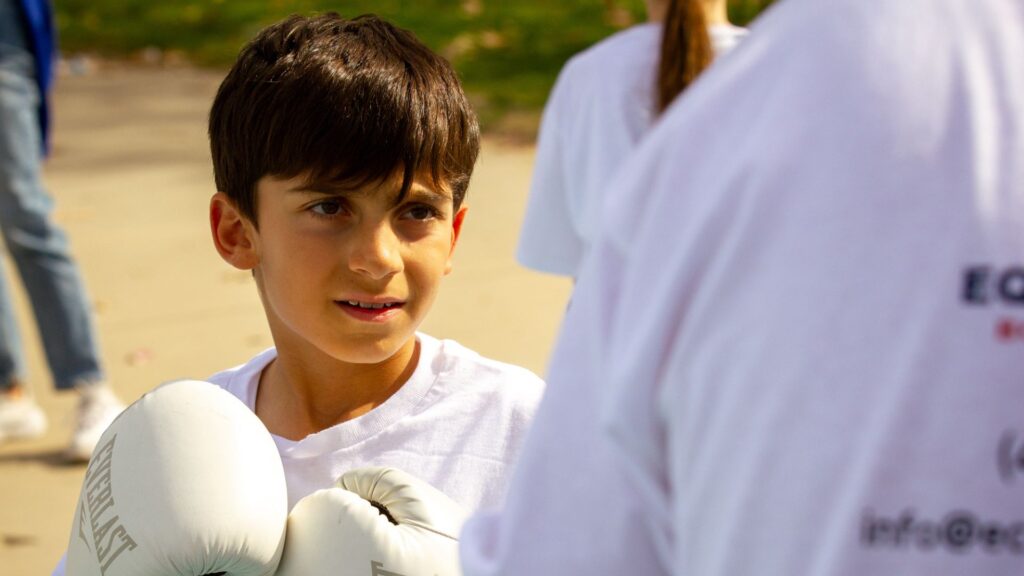
For generations, parents have wrestled with a deeply uncomfortable question: How do I protect my child in a world that isn’t always kind? When news stories highlight rising rates of school bullying, neighborhood violence, or digital harassment, the parental instinct is to build a wall around our children to keep them safe. But we cannot protect them from every physical or emotional confrontation. Eventually, every child will have to stand their ground.
When parents consider enrolling their children in martial arts for self-defense, boxing is often met with hesitation. The cultural image of boxing is frequently associated with aggression, bloody noses, and chaotic brawls. However, modern sports psychology and youth development experts have completely overturned this narrative. At the Equal Chance Boxing Foundation, we have witnessed thousands of transformations that prove a profound truth: Boxing is not about teaching a child how to start a fight; it is the ultimate science of teaching a child how to avoid one. In this massive, comprehensive guide, we will completely deconstruct the psychology of self-defense. We will explore the neuroscience of confidence, how predators choose their targets, why teaching a child to hit a heavy bag actually drastically reduces their physical aggression, and how the “sweet science” provides the most effective, real-world self-defense toolkit a young person can possess.
The Psychology of the “Soft Target” (Why Bullies Choose Who They Choose)
To understand why boxing is the ultimate form of self-defense, we must first understand the psychology of the aggressor. Whether it is a schoolyard bully or a street-level predator, aggressors rarely pick fights they think they might lose. Bullies are opportunistic; they actively scan their environment for “soft targets.”
A soft target is not necessarily the smallest child in the room. A soft target is identified entirely by non-verbal communication. Predators look for:
- Slumped shoulders and a downward gaze.
- A hesitant, shuffling walking pace.
- An inability to hold sustained eye contact.
- A nervous physical reaction when someone enters their personal space.
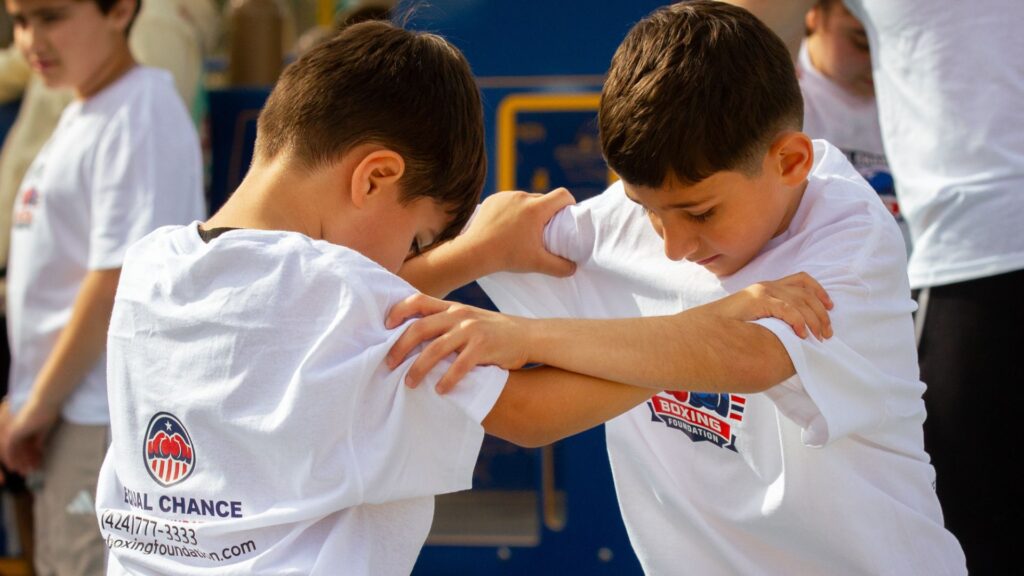
When a child joins a structured youth boxing program, the very first thing that changes is not their punching power—it is their physical posture. Boxing demands a specific biomechanical alignment. You are taught to keep your chin tucked, your eyes locked firmly forward on your target, your shoulders engaged, and your feet planted firmly beneath your center of gravity.
After just a few months of training, this athletic posture bleeds into the child’s everyday life. They walk down the school hallway differently. They hold their head up. When someone approaches them, they do not flinch; they make direct eye contact because they are used to making eye contact with opponents in the ring. This subtle but profound shift in body language is the first and most powerful line of self-defense. By simply carrying themselves like an athlete who knows their own strength, the child removes themselves from the “soft target” category entirely. They stop a fight before a single word is ever spoken.
The Paradox of Power (Knowing You Can Fight Means You Don’t Have To)
One of the greatest fears parents have is the “Myth of Induced Aggression.” The thought process goes: If I teach my child how to punch, won’t they become a bully themselves? Won’t they solve every argument with their fists?
The psychological reality is the exact opposite. Physical aggression in children and teenagers is almost always a byproduct of fear, insecurity, and a lack of control. When a child feels physically vulnerable, their nervous system is constantly on edge. If they are cornered or verbally insulted, they panic. Because they do not know what their bodies are capable of, they lash out wildly and unpredictably.
Boxing cures this insecurity through the Paradox of Power. When a teenager spends hours sweating in the gym, learning exactly how much force is required to move a hundred-pound heavy bag, and experiencing the physical exhaustion of a three-minute sparring round, they develop a deep, visceral respect for physical combat. They learn that fighting is exhausting, dangerous, and requires immense discipline.
A trained child is a calm child. When a young boxer is confronted by a bully in the schoolyard, they do not feel the same panic as an untrained child. Because they know exactly what they are physically capable of, they do not feel the desperate need to prove it to a stranger.
This profound self-awareness breeds incredible emotional regulation. A child who knows they can handle themselves in a physical altercation is far more likely to simply laugh off an insult, walk away from a tense situation, and de-escalate a conflict. They have nothing to prove. At Equal Chance, we constantly remind our youth: Your hands are registered tools of a sport, not weapons for the street. ## Part 3: The Adrenaline Dump and Real-World Reflexes
Let us assume the worst-case scenario: de-escalation fails, and a child is physically attacked. Why is boxing superior to other theoretical self-defense systems in a real-world crisis?
Many traditional martial arts teach highly choreographed, complex sequences of self-defense (e.g., If they grab your wrist, you twist your hip, pivot your foot, and apply a joint lock). While beautiful in a controlled dojo, these complex motor skills completely disintegrate in a real street conflict.
When a human being is attacked, the brain triggers a massive “adrenaline dump.” Heart rate skyrockets, fine motor skills vanish, and tunnel vision sets in. In this state of sheer biological terror, the body can only rely on gross motor skills and deeply ingrained reflexes.
Boxing is entirely built upon high-pressure, gross motor reflexes.
- Distance Management: Boxing teaches a child exactly how long a human arm is. They learn the intuitive skill of staying just one inch out of range, making it incredibly difficult for an attacker to grab or strike them.
- The Flinch Response: An untrained child will close their eyes, turn their back, and flinch blindly when swung at. A boxer has trained their flinch response to be tactical. They keep their eyes open, tuck their chin, and bring their hands up to form a physical shield around their brain.
- Footwork Under Fire: Instead of freezing or falling backwards, a boxer knows how to pivot off the center line. They use their legs to create space and escape the threat.
We are not teaching children to stand and brawl in the street. We are teaching them the precise biomechanical skills needed to block an initial attack, create a massive gap of physical space, and run to safety. Boxing teaches you how not to get hit, which is the ultimate goal of any true self-defense situation.
Emotional Self-Defense (Guarding Against Peer Pressure)
When we discuss self-defense, we almost exclusively focus on physical violence. However, the most common and destructive attacks teenagers face today are not physical; they are social and emotional. Peer pressure, toxic friend groups, and digital bullying destroy far more lives than schoolyard fights. How does a child defend themselves against a group of friends pressuring them to make a disastrous life choice? They need internal armor. They need a core identity that is stronger than the desire to fit in with the wrong crowd.
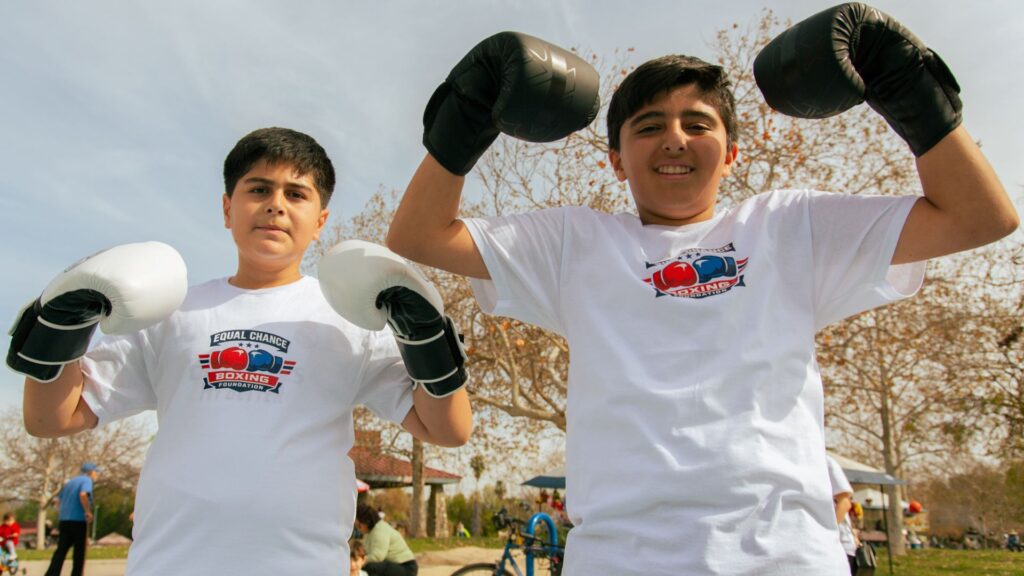
This is where the magic of our community training environments truly shines. When a teenager joins our foundation, they are stepping into an ecosystem built entirely on respect, hard work, and accountability. They are handed a clean white t-shirt—our ultimate psychological equalizer—and told that their past mistakes do not matter here.
Boxing builds emotional self-defense by providing a child with a profound sense of self-worth that is entirely independent of their peers’ opinions. When a teenager has survived a grueling training camp, pushed their body past its perceived limits, and earned the deep respect of seasoned coaches, the opinions of a high school bully suddenly carry very little weight.
- The ability to say “No”: A child who has the discipline to say “no” to junk food before a competition, or “no” to quitting during the third round on the heavy bag, develops the exact same neuro-pathways required to say “no” to drugs, alcohol, or toxic behavior in their social circle. They learn to stand their ground emotionally, which is the highest form of self-defense.
The “Corner Coach” Mentality for Life
In a self-defense situation, panic is the enemy of survival. The same is true for navigating the complexities of adolescence. When a child is overwhelmed by an academic failure, a family crisis, or a social rejection, they often spiral into anxiety because they feel utterly alone in the “ring” of life.
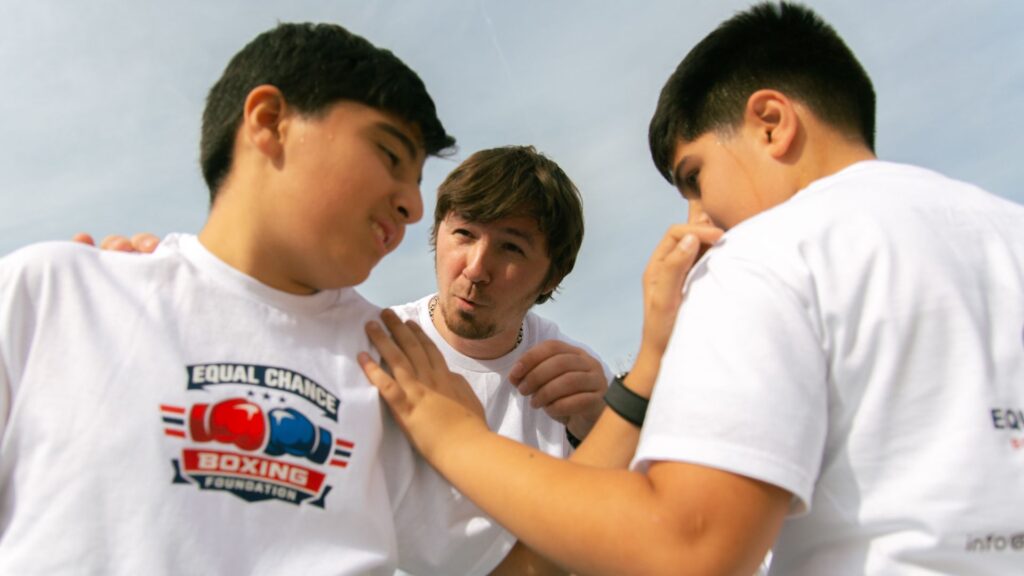
Boxing provides an unparalleled psychological safety net: The Corner. In our gyms, no athlete ever fights alone. They always have a mentor, a coach, and a team standing literally and metaphorically in their corner. We teach our youth that asking for help is not a sign of weakness; it is a tactical necessity.
By actively fostering this mentor-mentee relationship, we teach children how to seek out safe adults when they are in danger. A child who has been bullied, threatened, or abused is far more likely to report the situation to an authority figure if they have already learned how to trust a coach in the gym. We are building a communication bridge that allows them to defend themselves by utilizing the resources of their community.
How the Equal Chance Foundation Builds Bulletproof Youth
The transformation from an anxious, vulnerable child into a confident, self-regulated leader does not happen by accident. It requires a highly structured, expertly supervised, and deeply supportive environment. You cannot simply hand a child a pair of boxing gloves in the backyard and expect them to develop emotional resilience.
They need heavy bags to absorb their frustration. They need professional headgear to ensure they are physically safe while they learn to master their reflexes. They need open-air parks and dedicated spaces where they can train alongside peers from all walks of life, breaking down socioeconomic barriers and building true empathy.
This is the exact mission of the Equal Chance Boxing Foundation. We provide this world-class psychological and physical training entirely free of charge to the youth who need it the absolute most. We step into the gap before the streets claim another vulnerable teenager. We teach them how to fight for their education, their character, and their future.
Your Role in Their Defense: Be the Ultimate Corner-Man
We cannot build this impenetrable armor around our community’s youth without your help. The cost of running these programs—the permits, the safety gear, the professional coaching, and the facility maintenance—is immense. We rely entirely on a community of visionaries who understand that the best way to stop youth violence is to teach youth discipline.
We invite you to get involved with our movement. Whether you are a parent looking to volunteer, a community leader looking to advocate, or a donor looking to make a massive generational impact, there is a place for you in our corner.
When you make the generous decision to DONATE TO EQUAL CHANCE TODAY, you are directly purchasing a child’s safety.
- You are funding the safety gear that allows them to learn distance management without fear of injury.
- You are paying for the professional mentors who teach them how to de-escalate a street fight using only their words and their posture.
- You are providing a safe haven where a bullied child can finally take a deep breath, put on a pair of gloves, and discover exactly how incredibly powerful they truly are.
Self-defense is not a luxury; it is a fundamental human right. Do not let another child in our community walk through life feeling like a target. Join our fight. Support the mission. Give them the tools they need to stand tall, stay calm, and conquer whatever life throws their way.
Questions?
We’ve got answers.
Yes. Boxing focuses on the most practical aspects of self-defense: footwork, distance management, and head movement. It teaches a child how to stay out of range, how to stay balanced, and how to remain calm under pressure. Unlike many arts, boxing is a “live” sport where kids learn to react to real-time movement, which is the most critical skill for staying safe in an actual confrontation.
Actually, the opposite is true. Children who know they can defend themselves rarely feel the need to prove it. Boxing training instills a deep sense of responsibility; coaches emphasize that these skills are strictly for the gym or for personal safety. This “quiet confidence” allows a child to walk away from a provocation with their head held high, knowing they don’t need to engage to feel strong.
Boxing is excellent for “stress inoculation.” Through repetitive drills, kids become accustomed to the adrenaline of a fast-paced situation. They learn to keep their eyes open, breathe, and think strategically even when their heart rate is high. This training prevents the common “freeze” response, giving them the presence of mind to de-escalate or escape a dangerous situation safely.
The primary goal of the mindset we teach is “Awareness and Avoidance.” We teach kids that the best self-defense is not being there when the fight happens. Boxing builds the self-esteem necessary to set firm verbal boundaries and the situational awareness to recognize trouble before it starts. Physical defense is always taught as a necessary last resort to protect one’s safety, never as a tool for aggression.